
It’s 2am in a Khalidiya apartment, and you’ve just found today’s “gift” on the living room rug again. Third one this week. Your cat, meanwhile, is sitting a few feet away looking completely unbothered, mid-lick, as if nothing happened.
If this feels familiar, you’re not alone. Cat owners across Abu Dhabi deal with hairballs regularly, especially during heavy shedding periods when loose fur is easier for cats to swallow during self-grooming. Indoor living and constant air conditioning can also leave coats dry and prone to shedding.
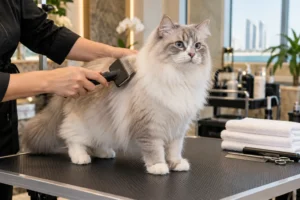
This is one reason regular pet grooming in Abu Dhabi can be helpful for cats that shed heavily. Professional brushing and de-shedding can remove loose hair before your cat swallows as much of it during grooming.
So why do hairballs keep happening, and when does a “normal cat thing” become something worth paying closer attention to? Here’s what’s really going on.
What Causes Hairballs in the First Place?
Cats are meticulous self-groomers, spending a large chunk of their waking hours licking their coat clean. Their tongues are covered in tiny, backward-facing barbs called papillae that work like a built-in hairbrush, catching loose and dead hair as they go. Most of that hair gets swallowed in the process.
Normally, swallowed hair moves through the digestive tract and exits the litter box the ordinary way. Problems start when hair builds up in the stomach faster than it can pass through, it clumps together and eventually comes back up as a hairball, known clinically as a trichobezoar.
Is This Actually Normal? Here’s What the Data Says
This is the part most cat owners get wrong, so it’s worth being precise about it.
What the research shows: Hairballs are the single most commonly reported concern among cat owners, cited by 35% of respondents in a Hill’s Pet Experience Study. Guidance from Cornell University’s College of Veterinary Medicine notes that a hairball every week or two isn’t unusual on its own, but more than one per week is a signal to book a vet visit. A veterinary review published in the Journal of Feline Medicine and Surgery goes further, noting that in short-haired cats especially, frequent hairballs are often a sign of an underlying issue, like skin disease, fleas, or a food intolerance, rather than just an eccentric grooming habit.
In other words: occasional isn’t a problem. Frequent almost always means something is driving it.
| Frequency | What it usually means |
|---|---|
| A few times a year | Normal, low-effort self-grooming |
| Every 1–2 weeks | Common, especially in shedding season, usually not concerning |
| More than once a week | Worth investigating, coat, diet, stress, or a GI issue may be involved |
| Retching with nothing produced | Contact a vet promptly, possible blockage |
Why Some Cats Get More Hairballs Than Others
Coat type and shedding season Long-haired breeds, Persians, Maine Coons, Ragdolls, Norwegian Forest Cats swallow more hair simply because they have more of it. Seasonal shedding, which in Abu Dhabi’s climate often overlaps with big indoor/outdoor temperature swings between AC-cooled homes and the heat outside, can push hairball frequency up temporarily for almost any breed.
Over-grooming:
Stress, boredom, skin allergies, or fleas can push a cat into compulsive grooming, and more grooming means more swallowed hair. Bald patches or grooming that looks anxious rather than routine is worth a closer look.
Diet and digestion:
Low-fiber diets make it harder for swallowed hair to move efficiently through the gut, increasing the odds it clumps up instead of passing through.
Age:
Older cats often groom less effectively due to stiffness or dental discomfort, which paradoxically leads to more loose, matted hair being ingested during the grooming they do manage.
Underlying health issues:
Chronic gastrointestinal conditions, inflammatory bowel disease, and motility disorders can all present as “just a lot of hairballs.” If frequent hairballs come with vomiting unrelated to fur, appetite loss, lethargy, or constipation, that’s a vet visit, not a grooming fix.
How Regular Grooming Helps Reduce Hairballs
The most effective fix is also the simplest: get rid of loose hair before your cat swallows it.
- Brushing at home several times a week (daily for long-haired cats) removes loose undercoat hair before it ends up ingested.
- Professional cat grooming in Abu Dhabi goes further than at-home brushing, a proper deshedding treatment and bath reaches the dense undercoat where most loose hair hides, which is exactly the hair a brush at home tends to miss.
- Regular trims for long-haired cats cut down on matting, which otherwise forces cats to over-groom problem spots and swallow even more hair.
For cats prone to frequent hairballs, consistency matters more than any single session. A cat groomed occasionally, “whenever we remember,” will accumulate more loose hair between visits than one on a set schedule.
If getting a stressed or carrier-averse cat across town for an appointment is part of what’s stopping you from staying consistent, Nin9 Tails’ mobile grooming service brings a fully equipped van to homes across Abu Dhabi, including MBZ, Khalidiya, and surrounding areas, so your cat gets the same deshedding treatment without the car ride or the stress of an unfamiliar salon. For cats who do better in their own space entirely, at-home grooming visits are also available.
When to See a Vet
Occasional hairballs are normal cat behavior. Contact a vet if you notice:
- Hairballs more than once a week
- Repeated retching that doesn’t produce anything
- Loss of appetite, lethargy, or a swollen abdomen
- Constipation or diarrhea alongside hairball symptoms
These can point to a blockage or an underlying condition that needs medical attention rather than a grooming adjustment.
Frequently Asked Questions
How many hairballs a month is normal for a cat?
A hairball every week or two is generally considered within the normal range. More than one per week, or a sudden jump in frequency, is worth mentioning to a vet.
Do short-haired cats get hairballs too?
Yes. Short-haired cats swallow less hair overall, so frequent hairballs in a short-haired cat are more often a sign of an underlying issue skin irritation, fleas, or diet rather than just coat volume.
Can grooming really reduce hairballs, or is it just diet?
Both matter, but grooming addresses the root cause directly: less loose hair on the coat means less hair available to swallow during self-grooming. Diet helps hair move through the gut once it’s already been ingested.
How often should I book professional cat grooming in Abu Dhabi to help with hairballs?
It depends on coat type long-haired cats typically benefit from monthly sessions, short-haired cats around every 6–8 weeks. Cats producing frequent hairballs may benefit from a tighter schedule during shedding season.
Is mobile cat grooming as effective as an in-salon visit?
Yes. Nin9 Tails’ mobile grooming van carries the same tools and products used in-salon, so deshedding and bathing are just as thorough with less stress for cats who don’t do well with car rides or unfamiliar environments.
When should I stop trying home remedies and call a vet?
If your cat is retching repeatedly without bringing anything up, refusing food, seems lethargic, or has a swollen abdomen, skip home remedies and call a vet the same day these can be signs of a blockage.
Conclusion
Hairballs are a normal part of a cat’s grooming instinct, but frequent ones are usually a sign that loose hair isn’t being managed efficiently, whether that’s coat type, shedding season, or grooming habits. A consistent brushing routine at home, backed by regular professional grooming, is the most reliable way to keep hairballs to a minimum and keep your cat comfortable no matter which part of Abu Dhabi you call home.
Nin9 Tails has been one of Abu Dhabi’s trusted pet grooming salons for years, with certified groomers experienced in handling cats of every coat type and temperament. Book a deshedding session in-salon or via mobile van and give your cat’s coat (and your living room rug) a break