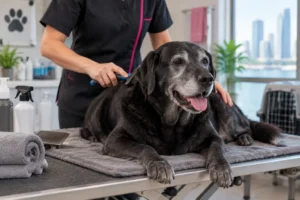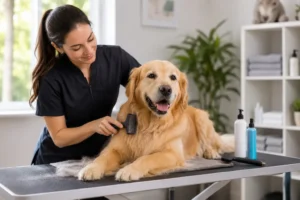

Bruno was twelve, a black Labrador with grey slowly spreading across his muzzle, and he had never once complained during a grooming session. For years, he had happily stood through baths, brushing, nail trims, and coat care without a fuss. Then one day during a grooming appointment, he gave a low, surprised growl, almost as if he was embarrassed by his own reaction. His owner immediately felt worried, thinking Bruno had suddenly become difficult.
But Bruno wasn’t being difficult. He was communicating. Standing still on a grooming table for forty minutes is very different for a senior dog whose joints, balance, and comfort levels have changed with age. The same grooming routine that felt easy five years ago may now require more patience, shorter sessions, and a gentler approach.
This is something many pet owners discover when looking for pet grooming in Abu Dhabi or arranging mobile pet grooming in dubai for their older dogs. Senior pets often need groomers who understand their changing needs from supporting tired legs during grooming to creating a calmer, more comfortable experience.
That growl wasn’t bad behavior. It was information. It was the moment Bruno’s owner realized that grooming an older dog is not about doing the same things slower, it is about adapting the entire grooming experience to the pet they have become.
Why Arthritis Changes the Whole Session
Osteoarthritis is not rare in older dogs. Veterinary literature puts it at roughly one in five dogs over a year old, and the figure climbs sharply with age a large majority of dogs over eight show degenerative joint changes on X-ray, whether or not their owners have noticed a limp.
That last part matters. Dogs are exceptionally good at masking joint pain. They compensate by shifting weight, shortening stride, and avoiding certain movements so gradually that owners adapt without registering the change. Grooming exposes it immediately, because grooming asks a dog to do the exact things arthritis makes hard: stand still, hold weight on three legs, turn the neck, lie on one side.
The old approach fails for a simple reason. A standard groom is built around the groomer’s convenience — one position, one long session, full standing. An arthritic dog needs the opposite: their comfort dictates the structure, and the haircut fits around it.
Signs the Session Is Hurting, Not Just Annoying
| Behaviour | What owners assume | What it usually means |
|---|---|---|
| Sitting down repeatedly on the table | Stubbornness | Hips or stifles can’t sustain standing |
| Sudden growl during a familiar step | Bad mood, “he’s grumpy now” | Sharp pain at a specific joint angle |
| Shifting weight constantly | Restlessness | Offloading a painful limb |
| Refusing to lift a back paw | Being awkward | Weight-bearing on the opposite hip hurts |
| Reluctance to turn the head for face work | Distraction | Cervical spine or neck stiffness |
| Excellent for 10 minutes, then difficult | Short attention span | Pain accumulating with time standing |
That last row is the clearest arthritis signature there is. A dog who starts well and deteriorates isn’t losing patience, they’re running out of tolerance.
Important: Any new resistance to grooming in a dog over seven should be treated as a pain question first and a behaviour question second. Book a vet check before assuming it’s temperament.
Positions That Actually Work
The single biggest improvement you can make is to stop insisting the dog stands.
1. Lying on the side, on a padded surface:
The best default position for arthritic dogs. It removes weight-bearing entirely and gives full access to one whole flank, both legs on that side, and the belly. Groom that side completely, then help the dog roll, don’t ask them to reposition themselves.
2. Sitting for all front-end work:
Face, ears, neck, chest and front legs can be done entirely from a sitting position. Many owners never realise how much of a groom this covers.
3. Floor-level, not table-level:
Table work means being lifted twice, and lifting an arthritic dog badly is a genuine injury risk. A non-slip mat on the floor works for most large seniors. If the dog must be lifted, support the chest and the hindquarters simultaneously — never under the belly alone.
4. Supported standing, in short bursts:
For the few tasks that need standing, a hand or a rolled towel under the abdomen takes weight off the hips. Ten to fifteen seconds at a time is plenty.
5. Never fully upside down:
Rolling a senior dog onto their back for belly or sanitary work compresses the spine and panics dogs who can’t right themselves quickly. Do belly work from the side-lying position instead.
Surface matters as much as position. The polished tile and marble floors common in UAE villas and apartments give an arthritic dog no grip at all, and the fear of slipping causes as much tension as the arthritis itself. A yoga mat or bath mat under the dog changes their entire posture.
Timing: When and How Long
Groom in the morning, not the evening:
Arthritic stiffness is generally worst after rest and again late in the day once the joints have been used. Mid-morning, after the dog has moved around a little but before fatigue sets in, is the usable window.
Warm the dog up first:
Five minutes of gentle walking, or simply letting them move around the room, loosens joints measurably before you ask them to hold a position.
Split one groom across several short sessions:
This is the change that helps most:
| Session | Focus | Duration |
|---|---|---|
| Day 1 | Left side, brushing and left legs | 10–15 min |
| Day 2 | Right side, brushing and right legs | 10–15 min |
| Day 3 | Face, ears, neck (sitting) | 10 min |
| Day 4 | Nails and paw pads | 5–10 min |
| Day 5 | Bath and dry, if needed | 20 min max |
Groom more often, not longer.:
Shorter sessions every two to three weeks beat one long session every eight. The coat never gets bad enough to require dematting, and the dog is never asked to endure more than they can manage. It also removes the worst scenario for a senior dog: a matted coat that forces a long, uncomfortable session.
Watch for the tap-out:
Stop at the first sign of shifting or sitting, even mid-task. An unfinished groom is fixable. A dog who now associates grooming with pain is a much harder problem.
What to Skip Entirely
- Full-body standing dryers: The heat and the forced standing are a poor combination. Towel-dry thoroughly and use a low-speed dryer at floor level.
- Aggressive dematting: Pulling at mats yanks on skin that’s already sensitive. On a senior dog, clipping the mat out is almost always the kinder call.
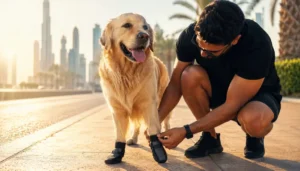
- Long nail sessions in one sitting: Overgrown nails alter a dog’s gait and add load to already painful joints, so nail care genuinely matters here but do two or three nails at a time rather than all sixteen. The same care that goes into protecting your dog’s paws from hot pavement applies to keeping their pads and nails comfortable year-round.
- Very short summer shaves: Older dogs regulate temperature poorly and often have thinner coats already. Trimming down is fine; shaving to the skin is not.
- The car journey: For a dog who struggles to jump, stand or balance, getting to a salon is often harder than the groom itself. Home-based sessions remove that entirely one of the more practical reasons pet parents in Dubai choose mobile grooming once their dog reaches double digits.
Conclusion
Grooming an arthritic senior dog isn’t harder, it’s just built differently. The three changes that matter most are position, timing and restraint: let the dog lie down instead of stand, groom in short morning sessions spread across the week, and drop the parts of a standard groom that ask too much of painful joints.
Get those right and grooming stops being something your dog endures. Long nails don’t build up, mats don’t force painful sessions, and you keep the one routine that lets you notice lumps, sore spots and stiffness early which for a dog in their senior years is worth more than a perfect haircut. Treat a groom that ends early as a success, not a failure.
Frequently Asked Questions
My dog was fine with grooming until recently. Could it really be arthritis?
Very likely. Sudden resistance in a dog over seven is a pain signal far more often than a behaviour change. Get a vet check before adjusting your grooming approach, because there may be treatment available that makes the whole thing easier.
Should I give pain medication before a grooming session?
Only what your vet has already prescribed, timed so it’s active during the session ask them what that timing looks like. Never give human painkillers, and never start anything new specifically for grooming without veterinary advice.
Is mobile grooming better for an arthritic dog?
Usually, yes. It removes the car journey, the lifting in and out, and the wait on a hard salon floor three things that tire an arthritic dog before grooming even starts. Some dogs also do better in surroundings they don’t have to navigate on stiff joints.
How often should I groom a senior dog with joint problems?
More often than you did when they were younger, but for less time each session. Short sessions every two to three weeks stop the coat reaching a state that requires long, uncomfortable work.
Can I still bathe my arthritic dog at home?
Yes, with a non-slip mat in the bath or shower and warm not hot water. Keep it brief, support the hindquarters, and skip the standing dryer. Many senior dogs find warm water eases stiffness rather than aggravating it.
My dog can’t stand for nail trims at all. What now?
Do them lying on their side, two or three nails per session across several days. If your dog resists all paw handling, have a groomer or vet do it rather than fighting through it at home a nicked quick on a senior dog sets progress back badly.
Grooming a senior dog is less about the finish and more about protecting a routine your dog can keep tolerating for years.